
Chao Fei (PhD candidate at UMR Eco&Sol) talked about „Soil microbial biomass phosphorus in cropland soils: a global meta analysis (in progress)“
Virtual Academy 30.06.2023
Simon Weldon (NIBIO, Norway) presenting „Understanding the root shoot database. What can we learn about management effects on the root biomass from the available literature in Europe?“
Virtual Academy 29.09.2023
Marton Toth (BOKU) presenting “Long-term effects of tillage systems on soil organic carbon and total nitrogen”
Geschützt: Virtual Academy 26.01.2024
EJP SOIL Annual Science Days & General Meeting, RIGA, Latvia, from 12 to 16 June

Riga Science day presented the opportunity for EJP soil participants to learn, discuss and exchange information.
MixRoot-C and MaxRoot-C held a fascinating break out session Carbon sequestration, roots and amendments: Highlights included:
- the paradigm shifting evidence, that there is no saturation limit for mineral associated organic carbon,
- data and reflections from last years MaxRoot-C field campaign which suggests site plays has a bigger influence than variety on below ground carbon allocation and mycorrhizal infection
- and finally that we need to align our methods for measuring and assessing root:shoot ratios.
Great talks and posters were presented from young and old, and lively discussions followed.
In the main sessions one of the key talks was about how we communicate amongst ourselves and with stake holders. This was highlighted by Felix Seidl and Axel Don et al., where they presented a great talk and poster on getting your carbon terminology right, and concluded that it would be good if we could all talk the same language. See the main conclusions in the poster here for your carbon duolingo!
Virtual Academy 26.05.2023
Lorene Siegwart, UMR Eco&Sols, Montpellier, France, will present
«An innovative method to assess in situ root decomposition at different soil depths: optical scanner-based images analysis»
Fr, 26.05.2023, 13-13:30 CET, Zoom link: https://bokuvienna.zoom.us/j/92666640682
Montpellier Workshop

We amassed in Montpellier for a MaxRoot-MIXROOT-C labelling workshop; superbly hosted by Isabelle Bertrand and her team at INRAE. We presented, discussed and developed new ideas and old ones, to come to a consensus on how best to label the plants and analyse the results.

The open knowledge exchange was a credit to the organisation and the participant’s willingness to share their tacit knowledge and insights for the common goal of the two projects. An admirable scientific spirit we have experienced since the outset of the joint projects.
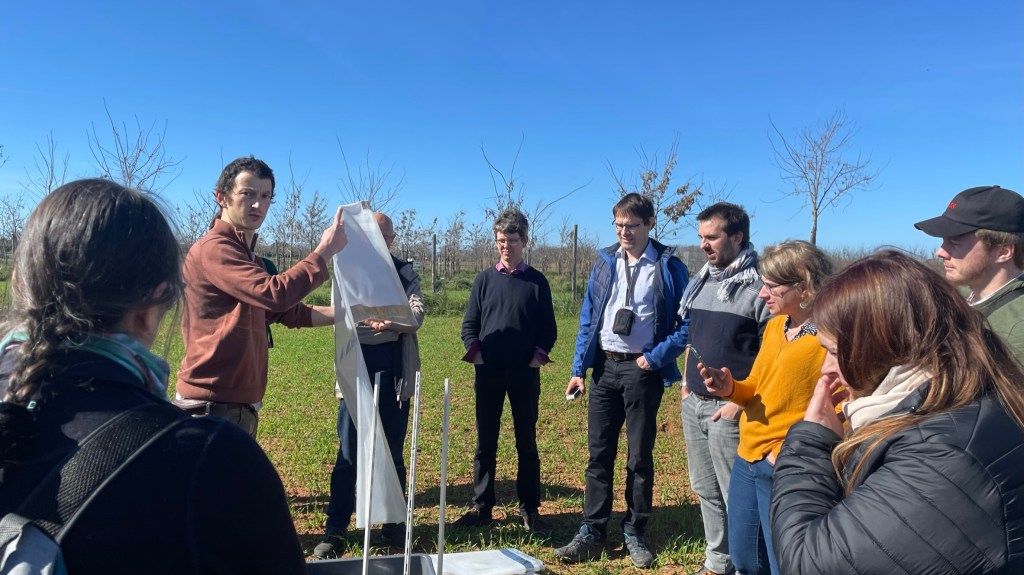
The highlights of the workshop were the hands-on root imaging training and the field-trip to the agroforestry site DIAMS just outside Montpellier. Here the roots of black locust-barley mix, is being investigated with a scientific scrutiny unrivalled in Europe. The deep trenches and windows offered opportunity to see the roots in the real-world environment. Whilst the instrumentation monitors every puff of carbon dioxide inhaled or root turned over.
We got a great demonstration of the isotope labelling technique and learnt many tricks and tips for the labelling season ahead.
VIDEO of the MaxRoot-C sampling tour
Soil: the final frontier. These are the voyages of the MaxRoot-C sampling team (Thünen & Agroscope). Its continuing mission: to sample roots of main crops across Europe. To seek out root biomass of 10 different varieties and to assess if an optimized variety selection for more root biomass could increase soil carbon. To boldly go where no one has gone before at temperatures that no one withstood before!
Tenure track position in Biogeochemistry of soil/plant interactions
We are going to open a Tenure Track position at INRAE in Montpellier.
This 3-yr Tenure Track contract will be followed by a permanent position of Senior Scientist (Directeur de Recherche) at INRAE.
More details here: https://www.umr-ecosols.fr/en/eco-sols/eco-sols-news/255-tenure-track-position-in-biogeochemistry-of-soil-plant-interactions
22.February 2023
Virtual Academy, 24.02.2023
„In situ visualization of phosphorus mobilization processes in the rhizosphere of field-grown Zea mays.“
Christina Hummel PhD candidate at
University of Natural Resources and Life Sciences, Vienna, Austria
© Christina Hummel

 MaxRoot-C & MixRoot-C